Monday, November 26, 2018

FORCED PERSPECTIVE


 WHAT IS FORCED PERSPECTIVE?


is a technique which employs optical illusion to make an object appear farther away, closer, larger or smaller than it actually is. It manipulates human visual perception through the use of scaled objects and the correlation between them and the vantage point of the spectator or camera.


WHAT DOES IT HAVE TO DO WITH YOU?


Well I am glad that you asked.  Your homework is to team up with a partner or group of no more than 4 people and create images that show forced perspective.  See samples below.  Every person must create an image.  So if there are 4 people to a group then there must be 4 images.  


HOW DO I DO THIS YOU ASK?


  • Well first, you will need a camera or phone with a camera.  

  • Include yourself in the picture.

  • Combine yourself with an object in a distant background. 

  • See the examples, everything will make sense.

  • Upload your images to instagram using the hashtag below or email them to Mr. Martinez at jesus.martinez@animo.org


#FORCEDPERSPECTIVEAWCPARM202


SAMPLES OF FORCED PERSPECTIVE


 I took this one outside a Target Store.


Tuesday, September 4, 2018

Time For Your 1st Research Assignment!

For your first research assignment you will create a presentation that promotes a particular artist from a particular art movement or genre.  For example, you could create a presentation about Vincent Van Gogh and Post-Impressionism.

Instructions: Choose an artist from the list below.  Next, do a google search to find out which art movement or genre he or she belongs too.  If the artist you have chosen is still alive then chances are he/she belongs to the contemporary art movement.  If you research does not say then shoot me an email.  Before you post your artist and genre, look at previous posts to make sure that someone has not already chosen your artist.   Your post should look like this: i.e. "artist : Pablo Picasso,  Genre: Cubism."   


Do not choose an artist that has already been chosen.  No more than one person per artist!  NO exceptions!  It does not matter of it was chosen by another student in a different period!


Your choice must be made by Sunday Sept. 9th by 7pm in order to receive credit.  Choosing artists are first come first serve.  It must be posted on the blog for approval.   

Some artists to choose from are Pablo Picasso, Vincent Van Gogh, Rene Magritte, Salvador Dali, Frank Stella, Takashi Murakami, Kara Walker, Judy Chicago, Georgia O'Keeffe, Leonardo DaVinci, Brunelleschi, Francis Bacon, Marcel Duchamp, Gustav Klimt, Seurat, Chuck Close, Richard Estes, Ralph Goings, William Beckman, Robert Cottigham, Gajin Fujita, Jim Lee, Mark Silvestri, Richard Serra, Andy Warhol, Jean Michel Basquiat, Jeff Koons, Cindy Sherman, Lee Bontecou, Toulouse Lautrec, Jacob Lawrence, Frida Kahlo, Diego Rivera, Ludwig Kirchner, Homer Winslow, Claude Monet, Francisco Goya, Paul Cezanne, Franz Marc, Paul Gauguin, El Greco, Degas, Michelangelo, Boucher, Rembrandt, Bosch, Bruegel, Titian, Caravaggio, Van Eyck, Rubens, Renoir, Piet Mondrian, Damien Hirst, Jose Clemente Orozco, Gerhard Richter, Chris Ofili, Manuel Ocampo, Fabian Marcaccaio, Laura Owens, Monique Prieto, Mathew Ritchie, Hokasai, Inka Essenhigh, Pia Fries, Arturo Herrera, Yishai Jusidman, David Hockney, Sean Landers, Tor-Magnus Lundeby, Lucy McKenzie, Julie Mehretu, Beatriz Milhazes, Yoshitomo Nara, Chatchai Puipia, Murat Sahinler, Atul Dodiya, Merlin Carpenter, Simon Berti, Haluk Akakce, Jorge Marin, Crystal Wagner, Tim Hawkinson, Andy Goldsworthy, Alexander Calder, David Zinn, Noma Bar, Joshua Allen Harris, Christian Faur, Axel Peemoeller, Theo Jansen, Patricia Piccinini, Ennio Marchetto, Katie Sokoler, de Kooning, Alex Ross, Brandi Milne, NoseGo, Norma Bar, Joshua Allen Harris, Christian Faur, Axel Peemoeller, Felice Varini, Theo Jansen, Patricia Piccinini, Ennio Marchetto, Katie Sokoler, Janet Echelman, El Anatsui, Zaria Forman, Dorian Lynde, Yinka Shonibare, Devorah Sperber, Filthy Luker, Courtney Mattison, Swoon, Yung Jake, Ester Roi, Adele Renault, Cayce Zavaglia, PES, T.S. Abe, Beth Lipman, Patrick Dougherty, Lui Ferreyra, Kehinde Wiley, James Turell, Jason Dussault, David Cho, Walter de Maria, Maya Lin, Paul Pfieffer, Tony Oursler, Chris Ofili, Yulia Brodskaya, and others.

You can find more artists at the following links: 

20 Artists to follow on Instagram 

144 Artists

8 Portrait Artists

12 Street Artists

7 Contemporary Sculptors

11 Fascinating Artists Inspired by Science 

10 Fiber Artists You Should Know

30 Most Popular Artists of Our Time

Huge List of Contemporary Artists

20 Most Influential Artists of 2017

18 Artists to Watch in 2018

20 Most Influential Artists of 2017  

6 Rising Artists You Must Know in 2018

9 Artists to Watch in January 2018

30 Most Popular Artists of Our Time


READ EVERYTHING BELOW THOROUGHLY, IF YOU HAVE ANY QUESTIONS PLEASE SEE ME DURING OFFICE HOURS. (Mondays and Thursdays after school in room 209)

This is not a group project so do not ask!!!!


DUE Monday Oct. 15th! 
Presentation Criteria: 

  • Presentation must be on Google slides.
  • Must have at least 6 slides.
  • Must include at least 4 color images (1 must be a picture of the artist, and the others of the artist's work). 
  • Each image of the work must have the artwork title, date created, size, and medium.
  • Must include a brief biography of the artist (at least 2 paragraphs worth).  Paraphrase or DO NOT COPY directly from sources.  
  • Must include a brief description of art genre or movement, and style.
  • Must include a brief interpretation of one of the works displayed using the Feldman Model for Art Criticism (Analysis and Interpretation paragraphs).  Paraphrase DO NOT COPY directly from sources. 
  • Must include a slide with list of references used at the end of presentation.   These should include books, websites, and etc.   

Presentation Sample of Image Set Up


Write Up for Artist Bio: (2 paragraphs)

Who is the artist?  Where is he/she from?  What kind of art does he/she create?  Where did he/she study?  What influenced he/she?  What was he/she's life like?  Who did he/she look up to?  Where did he/she live?  What genre did he/she belong to?  Why was he/she's work important?  How did he/she' work change society/art world?


Write Up for Art Work: (2 paragraphs)

FELDMAN MODEL FOR ART CRITICISM 


ANALYSIS:

How are the elements and principles of art used?  Give examples.  Is the work of art warm or cool? Are color schemes used?  What type of line is used? What shapes are there and how have they been arranged? Is there a sense of space or perspective?
Are there any special techniques used by the artist?
Here are a few things to consider when writing your ANALYSIS: Balance, Contrast, Repetition, Movement, Unity, Pattern, and Emphasis/Focal Point.  (Must use 4 out of 7)
Sentence starters: The work of art uses the elements..., Within the painting I see…,  The contrast  seems to be…,  Movement is used to…,  The focal point seems to be coming from…,  The work is balanced by…, The repetition of…, Line is used to…, The colors are warm/cool and…,


INTERPRETATION:

What does the work remind you of?  How does the work make you feel?  Why?   What do you think the artist was trying to say?  What is the goal of the artwork?  Are there symbols in the work?  What do they mean?  How can you relate to this work?  What do your personal experiences say about it?  Interpret the meaning of the work using specific evidence from the DESCRIPTION and ANALYSIS above to support arguments. 
Sentence starters: The work of reminds me of..., The painting makes me feel…,  The artist seems to be…,  The goal here seems to be…,  I can relate to this piece because…,  In looking back at my description, I can say that…, My analysis portion helps me to understand that…,

RUBRIC WILL BE COMING SOON!!!


Monday, August 27, 2018

Meticulous Drawing: Davit Yukhanyan


The Drawing above was created by Armenian artist Davit Yukhanyan.  

What is your first impression of this drawing?

What are the stronger elements of this drawing?  And why?  (i.e., line, shape, contrast, etc.)

How does the artist use line? 

What is the subject matter of this drawing?

Is this a simple drawing or a complex one?  Why?

How does Yukhanyan's resemble what we are currently doing in class?


Would you agree that this drawing required a lot of skill to complete?  If so, would you also agree that this drawing is more about skill and process rather than the subject or meaning?

Observe the images below:


After viewing these images, how has your outlook on the drawing changed?

How have some of your answers to the above questions changed?


Remember your answers/comments must be at least a paragraph long and include details.  
***********************Rules for Blogging:***********************************
*Blog responses are due Sundays by 7pm, no exceptions.
*You have one week to complete blogs
*All questions must have a response.
*Each response must be a paragraph (5-10 sentences)
*You must comment two other response blogs (agree, disagree, add to it, or make them understand your point of view)
*Your blog response must have your correct name and your class period. (or else how do I know who you are?)  

Thursday, August 16, 2018

Why is this Art?

The Merda d'artista, or as it is known in English, The Artist's Shit.  This is the title of the Italian artist Piero Manzoni's work on the left.  In May 1961, while he was living in Milan, Piero Manzoni produced ninety cans of Artist's Shit. Each was numbered on the lid 001 to 090.  He sold many of these as works of art and priced them at the value of gold.  He produced these at a time when his works were focused on the relationship between art production and human production.  It is speculated that the contents of the cans are indeed his very own excrement. 


Artist's Breaths (Fiato d'Artista), on the right, is another of Manzoni's works.  In this work he blew his breath into a series of colored balloons and mounted then onto wooden placks.


In your opinion can these truly be called a works of art?  Explain.   

Why would someone purchase any of these?  Explain.
Do you think that the artist is more interested in the artwork itself or in the idea or message behind it?

What is the message?  Why is it important?

Take one more look at Manzoni's work, then read the following quote and explain what you think it means.  

"Does this mean that anything can be art?  Or does it mean that almost nothing can?"

Explain....


***********************Rules for Blogging:***********************************
*Blog responses are due Sundays, no exceptions.
*You have one week to complete blogs
*All questions must have a response.
*Each response must be a paragraph (5-10 sentences)
*You must comment on someone else blog (agree, disagree, add to it, or make them understand your point of view)
*Your blog response must have your correct name and your class period. (or else how do I know who you are?)  

Thursday, May 3, 2018

Advanced Art: Stop Motion Animation

What is Stop Motion Animation?

Stop motion animation (also called stop frame animation) is animation that is captured one frame at time, with physical objects that are moved between frames. When you play back the sequence of images rapidly, it creates the illusion of movement. If you understand how 2D drawn animation (early Disney) works, stop motion is similar, except using physical objects instead of drawings.
The basic process of animation involves taking a photograph of your objects or characters, moving them slightly, and taking another photograph. When you play back the images consecutively, the objects or characters appear to move on their own.

(http://www.dragonframe.com/introduction-stop-motion-animation/) 


INSTRUCTIONS: 

Familiarize yourself with the text above.  Next, click on the link below and watch the stop-motion animation.  After watching the stop-motion return here to post your answers to the following questions. 


Coolest Stop-Motion Ever!


What impressed you most about the video?  Explain.

What kind of background was used in the video?  Explain.

How did the creator keep your attention?  Explain.

Did the animation flow smoothly or was it awkward?  How do you know?

What do you think was the most difficult part of this process?  Explain.

What seemed to be the most fun aspect and the most tedious?  Explain.

Do you feel that you learned anything about stop-motion from viewing this video?  Explain.

Any ideas come to mind for your very own stop-motion after watching this one?  Explain. 

Monday, April 30, 2018

Color and Victor Vasarely

The Works of Victor Vasarely: 


What effect are the complementary colors above creating?


Name the color scheme present above?


What illusion is being created?  How is it being created?  How do the different colors affect each other?  Explain. 

What color schemes are present above?  How do you know?  Explain. Hint: there are more than 2. 

***********************REMEMBER NEW RULES***********************************
*Blog responses are due Sundays, no exceptions.
*You have one week to complete blogs
*All questions must have a response. 
*Each response must be a paragraph (5-10 sentences)
You must comment on someone else blog (agree, disagree, add to it, or make them understand your point of view)
*Your blog response must have your correct name and your class period. (or else how do I know who you are?) 

Thursday, November 30, 2017

ADVANCED ART PODCAST FINAL EXAM

Hey all,

Take the time to look over and study the list of artists below for your Podcast:


Contemporary Artists:

NoseGo, James Turell, Dan Lam, Jen Stark, Ana Mendieta, Ai Weiwei, Luke Jerram, Susan Aldworth, Janet Saad-Cook, Fabian Oefner, Rachel Sussman, Maria Sibylla Merian, Andy Goldsworthy, Janet Echelman, El Anatsui, Zaria Forman, Dorian Lynde, Yinka Shonibare, Devorah Sperber, Filthy Luker, Courtney Mattison, Swoon, Yung Jake, Ester Roi, Adele Renault, Cayce Zavaglia, T.S Abe, Beth Lipman, Patrick Dougherty, Lui Ferreyra, Aaron Douglas, Romare Bearden, Lois Mailou Jones, William, H. Johnson, Jacob Lawrence, Kara Walker, Damien Hirst, Tim Hawkinson, Tom Friedman, Sarah Sze, Tara Donovan, Felix Gonzalez Torres, Walter de Maria, Tony Oursler, Paul Pfeiffer, Chris Burden, Crystal Wagner

Any artist not on this list must be approved first.

Information on many of the above artists can be found at the following websites: https://www.theartofed.com/2017/09/22/18-incredible-contemporary-artists-youve-got-check/

Remember that the first partnership to post a reply with their chosen artist takes ownership of that artist and others cannot choose that artist. 

Tuesday, August 22, 2017

Advanced Art: Life, Animals, People, and Art

Tiffany Bozic

Tiffany Bozic is an acute observer.  Her animal and plant life paintings are self-portraits.  According to her, the paintings are linked with her personal life emotionally.  She studies nature and its behavior which in turn helps her to create visually stunning and surreal works of art.


 What color scheme is present here?  How do you know?  Analyze this work.  What do you see?  Explain what you think it means.  What elements and principles are being used?

 
 What color scheme is present here?  How do you know?  Analyze this work.  What do you see?  Explain what you think it means.  What elements and principles are being used?

 ***********************REMEMBER NEW RULES***********************************
*Blog responses are due Sundays, no exceptions.
*You have one week to complete blogs
*All questions must have a response.
*Each response must be a paragraph (5-10 sentences)
You must comment on two other blog responses (agree, disagree, add to it, or make them understand your point of view)
*Your blog response must have your correct name and your class period. (or else how do I know who you are?)

Monday, May 29, 2017

Surrealism


Observe the 2 Surrealist paintings above.  One is an older painting by Rene Magritte (you learned about him in class) called Time Transfixed and the other is Rain Spell by Temporary Peace.  Keep in mind that Time Transfixed was created in 1938 and the Rain spell was created sometime within the last 10 years.  
1.  In your opinion, how has Surrealistic painting changed from Magritte's time to recent works?  Give examples. 
2.  What subjects or objects within the paintings suggest things that were important from the time periods?
3.  Make comparisons, what do both have in common?  What is different?  
4.  How do both paintings follow the characteristics of Surrealism?  (Dreamlike state of mind, fetish, and items that don't belong.) 
Make sure you answer intelligently and in complete sentences.  Also don't forget to respond one other person's respond.

Dream like state of mind: a feeling of euphoria a sense of the surreal, out of reality.

Distortion: the manipulation of images or objects.

Juxtaposition or displacement: items out of place, items together that don’t belong.

Fetish: an obsession with something, an idea or object.

***********************REMEMBER NEW RULES***********************************
*Blog responses are due Sundays, no exceptions.
*You have one week to complete blogs
*All questions must have a response.
*Each response must be a paragraph (5-10 sentences)
You must comment on someone else blog (agree, disagree, add to it, or make them understand your point of view)
*Your blog response must have your correct name and your class period. (or else how do I know who you are?)  


Tuesday, May 2, 2017

ADVANCED ART CLASS: LA LOTERIA

La Loteria Unit is here!  


Your Task: 

You are to look up the several image of La Loteria Cards.  When you find 3 that you like.  (These will be the same 3 that you will base your artwork on).  You will develop a riddle for each one.  See examples above.   You will type your riddles into the comment box.

***********************REMEMBER NEW RULES***********************************
*Blog responses are due Sundays, no exceptions.
*You have one week to complete blogs
*All questions must have a response. 
*Each response must be a paragraph (5-10 sentences)
You must comment on someone else blog (agree, disagree, add to it, or make them understand your point of view)
*Your blog response must have your correct name and your class period. (or else how do I know who you are?)


Monday, May 1, 2017

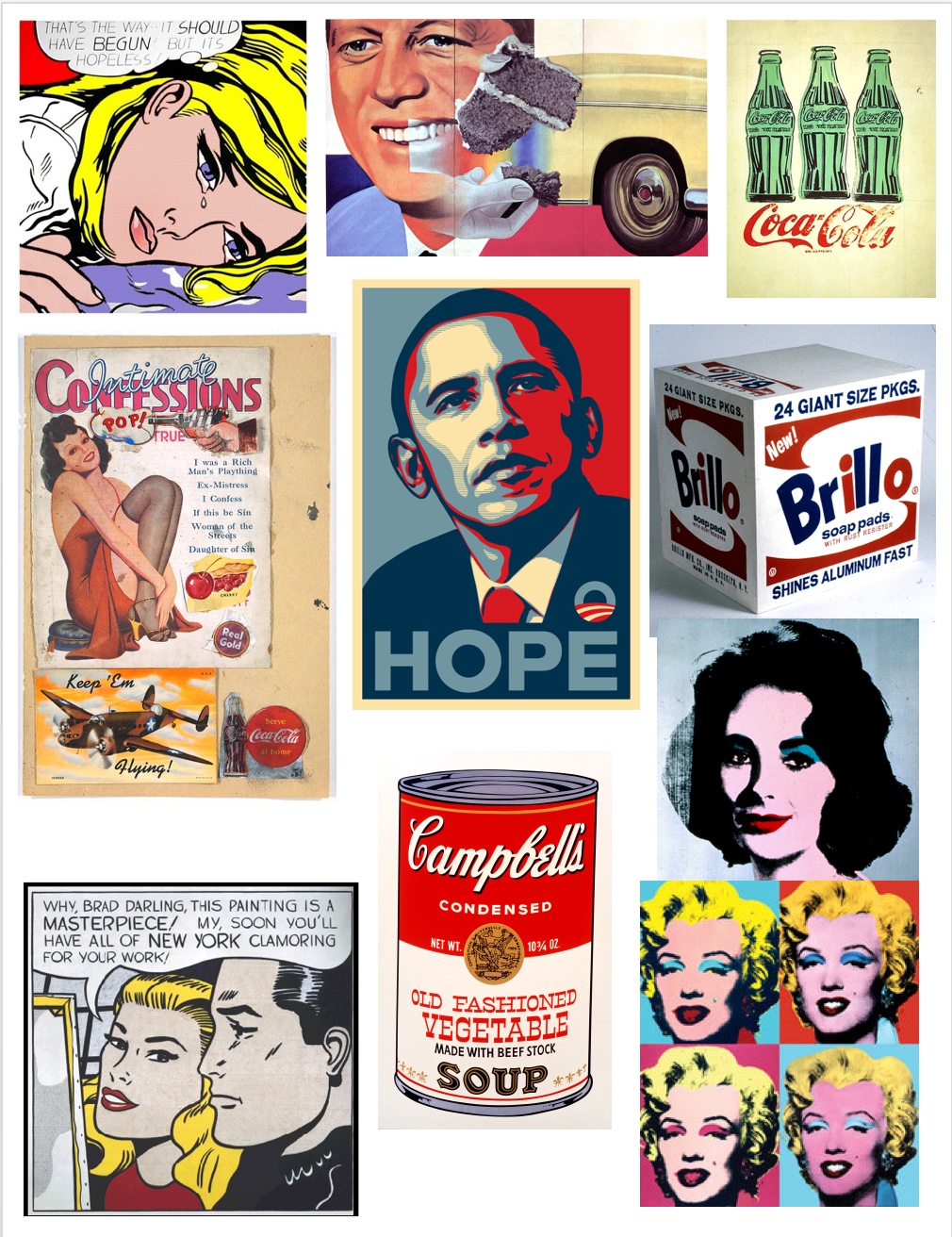
Pop Art Characteristics

What Are the Key Characteristics of Pop Art?

  • Recognizable imagery, drawn from popular media and products.
  • Usually very bright colors.
  • Flat imagery influenced by comic books and newspaper photographs.
  • Images of celebrities or fictional characters in comic books, advertisements and fan magazines.
  • In sculpture, an innovative use of media


Observe the images below and using the information above determine whether they are Pop art or not.  Choose a minimum of 3 images.  Write your responses below (4 sentence minimum). 


***********************REMEMBER NEW RULES***********************************
*Blog responses are due Sundays, no exceptions.
*You have one week to complete blogs
*All questions must have a response. 
*Each response must be a paragraph (5-10 sentences)
You must comment on someone else blog (agree, disagree, add to it, or make them understand your point of view)
*Your blog response must have your correct name and your class period. (or else how do I know who you are?)


Tuesday, April 18, 2017

HOW TO POP ART


Hey all,

The following is information intended to supplement what we have learned in class.  Please take the time to view all the videos and read all of the information.


The key characteristics of Pop Art
Recognizable imagery, drawn from popular media and products.
Depiction of popular consumer products.
Usually very bright colors and high contrast.
Flat imagery influenced by comic books, newspapers, photographs.
The use of Ben‐day dots.
Images of celebrities or fictional characters in comic books, advertisements and fan magazines.
In sculpture, an innovative use of Media.

The following links are to videos that will provide information, ideas, techniques, and ways on how to begin your Pop Art Chucks work of art.

A GUIDE TO POP ART

WHAT IS POP ART?  TATE KIDS

HOW TO DRAW A POP ART PORTRAIT

HOW TO DRAW POP ART LIPS

LADY GAGA POP ART

HOW TO DRAW POP ART PICTURES

Once you have watched all of the videos, describe how you plan to complete you Pop Art Chucks in a comment below.  (minimum 5 sentences).

***********************REMEMBER NEW RULES***********************************
*Blog responses are due Sundays, no exceptions.
*You have one week to complete blogs
*All questions must have a response. 
*Each response must be a paragraph (5-10 sentences)
You must comment on someone else blog (agree, disagree, add to it, or make them understand your point of view)
*Your blog response must have your correct name and your class period. (or else how do I know who you are?)


Tuesday, February 7, 2017

COLOR: VISUALLY APPEALING

This week I would like top to think about how color affects the decisions you make.  Many of us are attracted to specific color combinations.  Because of this attraction color is a very helpful in sales and marketing.  Consumers love attractive packaging designed with amazing color combinations.

In this same manner, graphic artists love to work with color because it is appealing to the eye.  Website designers are always looking for the best ways to attract people to their websites.  The link below will take you to a website that has various samples of website designs.  

WEBSITE COLOR SCHEMES

Your task is to:

Choose the one Website Design that appeals to you the most and answer the following questions:

What is the name of the design?

Why have you chosen this design?  Explain.

What first attracted you to this design? Explain.

What color schemes are present in the design?  How do you know?  Explain.

What else caught your eye?  Explain.

Was the rule of thirds used?  Explain.

How does the layout of the design work with the color?  (movement, focal point, contrast, rule of thirds, pattern, shape, etc?)  Explain.


***********************REMEMBER NEW RULES***********************************
*Blog responses are due Sundays, no exceptions.
*You have one week to complete blogs
*All questions must have a response. 
*Each response must be a paragraph (5-10 sentences)
You must comment on someone else blog (agree, disagree, add to it, or make them understand your point of view)
*Your blog response must have your correct name and your class period. (or else how do I know who you are?)


Monday, January 30, 2017

COLOR SCHEMES

IDENTIFY ALL OF THE COLOR SCHEMES ASSOCIATED WITH EACH PAINTING BELOW.


The work above by Piet Mondrian displays what color scheme?  Explain.


What color scheme did Picasso use in the painting above?  Explain.


What color scheme did Monet us in the painting above?  Explain.


***********************REMEMBER NEW RULES***********************************
*Blog responses are due Sundays, no exceptions.
*You have one week to complete blogs
*All questions must have a response. 
*Each response must be a paragraph (5-10 sentences)
You must comment on someone else blog (agree, disagree, add to it, or make them understand your point of view)
*Your blog response must have your correct name and your class period. (or else how do I know who you are?)


Tuesday, January 24, 2017

Color: Learning to see

Hello all, as we prepare to move into color in the next unit, I want to give you an opportunity to prepare your minds for the fascinating and complex world of color. 


Observe the image above.  How many types of yellow do you think are present?  Why would an artist choose to make a painting with only one color?  Explain.  How do you think the use of one color affects how the viewer sees or perceives the work of art?  Explain.   And lastly, what perspective is used here?  Explain.


Observe the image above.  This is Picasso's the Old Guitarist, a work of art from his Blue period.  How do you think the use of one color affects how the viewer sees or perceives the work of art?  Explain.  Was using blue a wise choice?  Explain.  What feelings may this painting bring out in viewers?  Explain.  Why do you think Picasso chose to not paint the guitar blue?  Explain.


***********************REMEMBER NEW RULES***********************************
*Blog responses are due Sundays, no exceptions.
*You have one week to complete blogs
*All questions must have a response. 
*Each response must be a paragraph (5-10 sentences)
You must comment on someone else blog (agree, disagree, add to it, or make them understand your point of view)
*Your blog response must have your correct name and your class period. (or else how do I know who you are?)


Sunday, January 1, 2017

Jason Borders

 Jason Borders is an Oregon based artist who carves skulls by hand using a dremel tool (like a power drill with many tip attachments).  Many of the motifs and patterns in his work often repeat lines, shapes, and other elements resulting in a sort of indigenous or tribal aesthetic.  


What does Jason Border's work remind you of?  Explain.

How does he use the elements and principles?  Explain.

How does his work resemble tattooing?  Explain.

By carving on the skulls of something that was once alive could Jason be attempting to convey a message to his audience?  What could that message be?  Or what is his work about?  Explain.  (Use the techniques from Feldman Model to assist you)

***********************REMEMBER NEW RULES***********************************
*Blog responses are due Sundays, no exceptions.
*You have one week to complete blogs
*All questions must have a response. 
*Each response must be a paragraph (5-10 sentences)
You must comment on someone else blog (agree, disagree, add to it, or make them understand your point of view)
*Your blog response must have your correct name and your class period. (or else how do I know who you are?)